The Hidden Tax on Your Dopamine
Why the Virtual Queue is the Ultimate Dark Pattern

Gagan Malik
Sunday, November 30, 2025
4 min read
OPINIONS
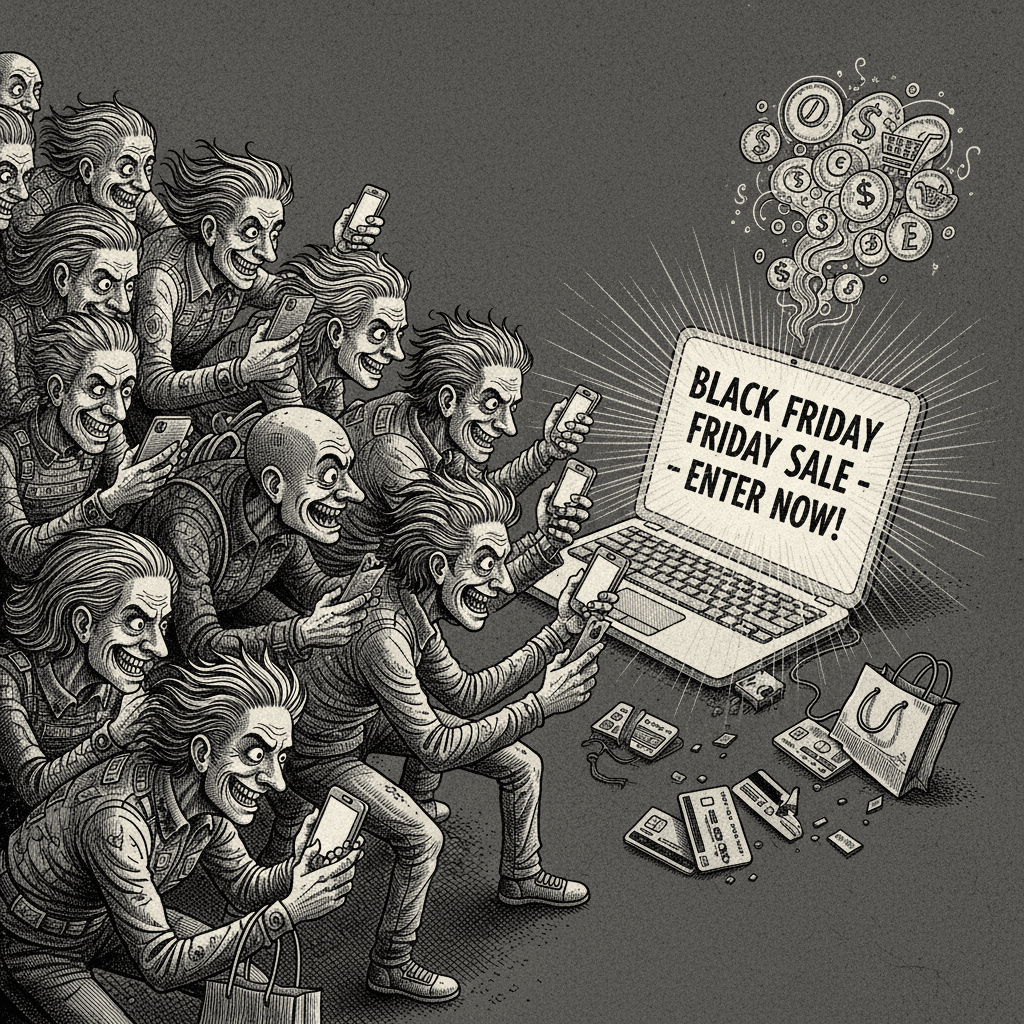
Let’s be adults for a second. I know you think you’re smart. I think I’m smart. I’ve built tech companies and led product and design teams. And yet, last Friday, I sat in a 'Virtual Waiting Room' for 43 minutes to buy a coffee grinder I don’t need, for a kitchen I rarely use, because a little green progress bar told me I was 'in a queue'.
I didn’t want the grinder. I wanted to win the queue.
We need to talk about the hidden design problem behind Black Friday. It’s not just the flashing 'Buy Now' buttons or the fake countdown timers. It’s something far more insidious, something the team at UX Collective nailed this week: the weaponisation of fairness.
The Theatre of Fairness
Here’s the open secret in the ops world: We don’t use virtual queues just to keep servers from crashing. We use them because they are the greatest conversion tool ever invented. In 2024, retailers didn’t just manage traffic; they choreographed it. Companies like Queue-it and Queue-Fair pitch their software as a way to ensure 'fairness at scale', protecting us from bots and stampedes. And sure, 87% of you say you’d rather wait in a queue than see a crashed website.
But here’s the economic reality: The queue creates value where there is none. It effectively digitises the nightclub velvet rope. By making you wait an average of 53 minutes, retailers are hacking your brain’s 'sunk cost' bias. You’ve already invested the time; walking away empty-handed feels like a loss.
When Dutch retailer Winkelstraat.nl turned on their waiting room, they didn’t just save their servers, they saw conversion rates skyrocket. Why? Because by the time you get to the front of the line, you aren’t a shopper anymore. You’re a survivor. And survivors spend money.
The 92% Lie
Once you’re through the velvet rope, the real gaslighting begins.
You think you’re getting a deal. You’re not. A rigorous investigation by Which? found that 92% of Black Friday deals were actually cheaper or the same price at other times of the year.
Ninety-two percent. If I ran a SaaS company with 92% downtime, I’d be in prison. But in retail, we call this "dynamic pricing strategy."
We are seeing the industrial-scale deployment of Dark Patterns, UX choices designed to trick you. We’re talking about "Activity Messages" (e.g., “14 people are looking at this right now”) that leverage social proof to spike your cortisol. We’re talking about "phantom stock" levels that never seem to drop below "Only 3 left!" until the moment you click buy.
This isn't accidental. It’s a dragnet designed to catch your attention deficit. And it’s working. UK consumers alone dropped £6.4 billion this weekend. But look closer at the data, and the "growth" starts to look a lot like inflation in a trench coat.
The Hangover is Real and it’s financed
Here is where the 'smart business' rhetoric falls apart. If we were selling genuine value, the numbers would be clean. They aren’t.
First, we are financing this dopamine hit with debt. Buy Now, Pay Later (BNPL) usage surged 9.6% this year, hitting $18.2 billion in the US alone. That’s not disposable income; that’s future austerity packaged as four easy payments. We aren't getting richer; we're just getting better at borrowing from our future selves to buy 4K TVs today.
Second, the waste is astronomical. We’ve optimised the "Buy" button to be frictionless, but we’ve completely ignored the "Keep" part. Return rates peaked at 17.7% post-Christmas last year.
Do you know what happens to a 17% return rate in a low-margin business? It eats the P&L alive. The logistics cost of processing those returns often exceeds the value of the goods. We are shipping plastic across the ocean, trucking it to your door, and trucking it back to a landfill, all so you can feel a fleeting moment of acquisition.
Milton Friedman would call this a misallocation of resources. I call it a stupid way to run an economy.
The Fix
I love tech. I love capitalism. But I hate bad design.
The 'hidden design problem' is not a glitch; it's the business model. We have built an entire digital economy on the premise that friction is bad. But maybe we need friction. Maybe the "Buy Now" button should actually ask, "Are you sure?"
Until then, here is my advice for the next time you see a virtual queue or a "Only 2 Left!" warning: Close the tab.
The only winning move is not to play unless it’s a really, really good coffee grinder! Then send me the link.